Around this time of year, some first year students (and others too) start to realize that they actually don’t know how to effectively study, learn material, and prepare for tests. The memorization and rote learning strategies that may have been OK for high school usually don’t work well at the university level. It’s not too late to change however, and there are various resources available to help, including at our Student Success Office. There are some that are more engineering-specific, such as the following one I found a few years ago. Continue reading
Engineering Education
Architectural engineering students start learning by doing – Waterloo Engineering
Students in our new program, off to a quick start on group design-build projects.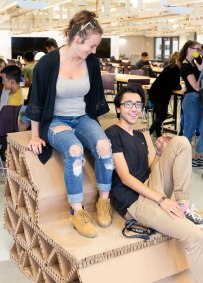
Students in new program challenged to work in groups to brainstorm, design and build furniture using cardboard, plaster and their collective creativity
Source: Architectural engineering students start learning by doing – Waterloo Engineering
Engineering Failure Rates-Redux
Here’s an update on a popular old post, with some new data and comments.
I’m never quite sure why people ask about failure rates, or what they are expecting. Do they want to hear that the failure rate is high, so they are convinced it’s a tough (and therefore good) program? Or maybe they don’t want the failure rate to be high, because they are concerned that they won’t be successful? I’m not sure what the motivation for the question is, but anyways let’s examine failure rates. Continue reading
Applying to University Should be Like Applying for Jobs
As high school students return to class, here is some key advice for those planning to apply to university or college. I strongly suggest that when applying to a post-secondary program, it should be treated like applying for a job or career. There should be some significant self-reflection and “selling yourself” to the university. The self-reflection part is derived from Prof. Larry Smith’s book, which I have briefly reviewed before. It’s very important to know why you’re doing something before doing it. The “selling yourself” part builds on this, and can be illustrated with an example that is a composite of stuff we see for Engineering applications. For this example, let’s consider two hypothetical applicants to Mechanical Engineering, both with similar grades (say low 90’s) and similar other activities. Each applicant writes something in their Admission Information Form, along the lines of the following… Continue reading
German Baking
Waterloo Region has a long history of German immigration and influence since its initial settlement, leading to place names like Berlin (now Kitchener), New Hamburg, Baden, and local events like Oktoberfest. Around the area you can find various places with German-style cuisine and products including at the bakery featured in this local news video link: https://kitchener.ctvnews.ca/video?clipId=1477166 From personal experience, their Christmas Stollen bread and chocolates are highly addictive. But what does this have to do with chemical engineering? Continue reading
Engineering 101 Welcome
Engineering 101 is a type of orientation event held in July for new admitted students. It’s an opportunity to come to campus and look around, meet some fellow students, get some tips for success, and get some errands done before the rush starts in September. There is an online guide summarizing everything, which is good for those who can’t make the trip or who want to review some of the advice.
I was asked to make some opening remarks, so following is a version of what I said. Continue reading
Ideas Clinic-Scanning Tunneling Microscope
I was visiting my colleagues in the Engineering Ideas Clinic the other day, to discuss a design-fabricate-test project for a heat exchanger that we’re working on for Chemical Engineering students. The basic concept for the Ideas Clinic is that students can do hands-on activities requiring engineering design, some fabrication and assembly, and some performance testing, part of our experiential learning philosophy. A bunch of activities have been developed over the past few years, and many more are in development to take advantage of new space available in our Engineering 7 building, opening soon.
One activity they previewed for me was the building of a desktop Scanning Tunneling Microscope for imaging surfaces at the atomic scale. The video below shows the basic principle of an STM. Once it’s finalized, this will be an activity for our Nanotechnology Engineering students, and it’s amazing that something like this can be built by students for a couple of hundred dollars. I look forward to seeing it in action.
Co-op students build first-of-its-kind machine in Canada | Engineering | University of Waterloo
An interesting article about some co-op student efforts in one of our research labs. I learned about Spatial Atomic Layer Deposition, which is an interesting application of nanoscience and materials engineering.
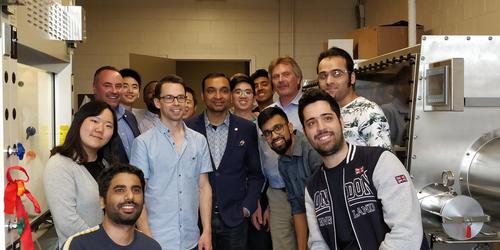 With the help of seven University of Waterloo co-op students, Canada’s first Spatial Atomic Layer Deposition (SALD) system is up and running. At the celebratory ribbon cutting on May 10, 2018, project leader Professor Kevin Musselman said he couldn’t have done it without the co-op students who helped design and build the machine. “I was sitting at my desk the whole time. I don’t think I ever lifted a finger so it was entirely built by the students,” laughs Musselman.
Source: Co-op students build first-of-its-kind machine in Canada | Engineering | University of Waterloo
These Are The Most Valuable Degrees In Canada In 2018
I’m always a bit wary of these rankings and their validity, but I’ll like this one because it has Chemical Engineering and Geosciences (which would include our Geological Engineering) in the top 5. From Huffington Post…
The list ranks the top-10 bachelor’s degrees based on the highest average salaries as well as the most recent available tuition costs.
Source: These Are The Most Valuable Degrees In Canada In 2018
Teaching Climate Change
Since the 1990’s I’ve been teaching an elective course on Air Pollution Control. We mainly focus on design of industrial systems, but I do include a small module on climate change science for background as to why certain things need emission control. Over the past decades, some of the reports and discussions in the media and politics have been confused or nonsensical, so I try to keep it straightforward and factual. I like to give the science a historical overview and context, to show where this all comes from. The following is a very brief version of that overview.
The French scientist Joseph Fourier (famous for his work in heat transfer and mathematics) is credited for identifying the so-called “greenhouse effect” in the 1820s. He didn’t know exactly what caused it, but recognized that the Earth’s surface is warmer than it theoretically should be, if there was no atmosphere trapping heat.
Some of the mechanisms behind the heat-trapping effects of the atmosphere were eventually identified, notably by the Irish physicist John Tyndall in the 1850s through his work on absorption spectroscopy. He experimentally measured the heat absorbing effects of water vapour, carbon dioxide and other atmospheric gases. These measurements and those by others provided the fundamental basis for the advances in radiative heat transfer used throughout science and industry to this day.
In retrospect, a big step forward in understanding and quantifying the physics of climate change came with work published in 1896 by the Swedish physicist/chemist Svante Arrhenius. The first page of this work is pictured below, and in this work he calculated how much the global temperature would rise if carbon dioxide concentrations rose.
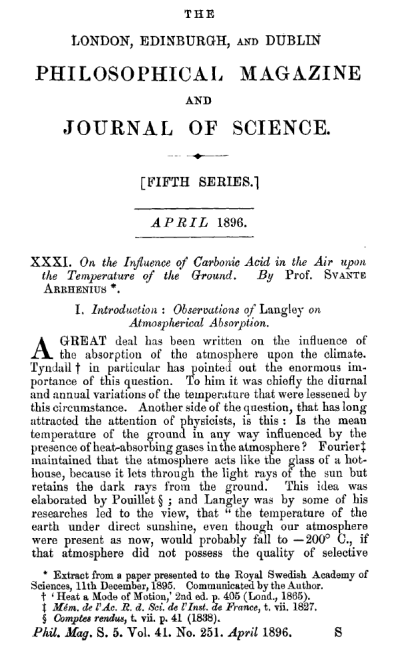
First page of Arrhenius’ paper on the climate effects of changing carbon dioxide concentrations. “Carbonic acid” is an older or alternate name for carbon dioxide in the presence of water.
Arrhenius is well-known by anyone who has taken chemistry (Arrhenius equation in reaction kinetics), and he received a Nobel Prize for Chemistry. His work on climate change physics didn’t seem to receive much widespread attention at the time, since there was no particular concern that carbon dioxide concentrations were rising. However it’s regarded as the first significant attempt to analyze the physics of rising carbon dioxide concentrations and over the subsequent century many scientists have modified and improved upon his initial work. Arrhenius had to go through some rather complicated and laborious hand calculations, but in recent decades computers have made that work much easier and more precise.
So from this brief historical overview in my class (including some other work not mentioned here), we can see that climate change science has a solid basis in physics, dating back over 100 years. Denying the basic physics of climate change is like denying the Bernoulli principle while watching airplanes fly overhead, or stepping off a cliff and denying that gravity exists.
Next I usually show some data for carbon dioxide concentrations in the atmosphere, usually from the Mauna Loa observatory operated by NOAA in the U.S. An example is shown below that also includes my additions to illustrate the years when international agreements have been signed to combat climate change at Rio, Kyoto, and Paris. Unfortunately, the upward trend doesn’t seem to have been affected much, which is a bit depressing when considering our next generations.

Carbon dioxide measurement data since 1958.
In my class we then touch briefly on some of the current and future effects of climate change, such as sea level rise, extreme precipitation events and flooding, drought, and heat waves. I ask students to try out one of the simpler carbon footprint calculators so they can see how their lifestyle contributes to carbon dioxide emissions. They frequently comment on how surprising it is that air travel and meat consumption are significant factors in their total impact. These estimates can help people understand the context and future challenges.
Finally, I conclude that as soon-to-graduate new engineers they will be dealing with climate change directly or indirectly throughout their careers. Maybe helping with carbon emissions reductions, energy efficiency, electrification, alternative energy, process and materials redesigns. Or if nothing much is accomplished in carbon dioxide emission reduction, dealing with the effects such as infrastructure repair and replacement, and water supply issues. As a bit of personal advice, I usually recommend that they avoid purchasing property in coastal or low-lying areas, or anywhere within a 500 to 1,000 year flood plain.
 A Professor in Waterloo Engineering