Canadian Co-op Programs Blend Classroom, Work Experience | Best Global Universities | US News

A nice overview article about co-op education from U.S. News , featuring one of our Management Engineering students.  Follow the link for the full article.

Sarb Majumdar, of Singapore, is a fourth-year management engineering student at the University of Waterloo in Canada. But if you go to Waterloo and search for him right now, you won’t find him.

He’s in Toronto this term, working full time as a software developer.

Source: Canadian Co-op Programs Blend Classroom, Work Experience | Best Global Universities | US News

Amazon partners with Waterloo to support AI research | Waterloo Stories

A link below to an interesting development, where Amazon is providing Waterloo Engineering and 3 other U.S. universities with support and Alexa-enabled devices  for use in teaching, research and student design projects. 

Photo: cofoistome/iStock/Thinkstock

Recent advances in the fields of human-machine interaction and artificial intelligence (AI) have been so swift that even experts like Fakhri Karray shake their heads in amazement.

Source: Amazon partners with Waterloo to support AI research | Waterloo Stories

An Amazing Statscan Skills Study | HESA

Source: An Amazing Statscan Skills Study | HESA

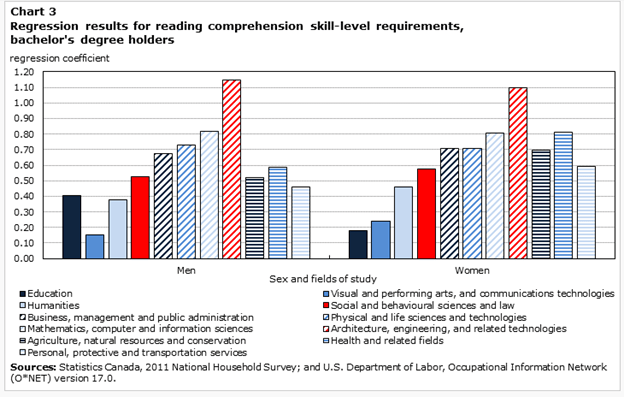
An interesting post from our friends at Higher Education Strategy Associates, summarizing a Statistics Canada study on employment skills requirements.  A couple of graphs are reproduced below,  and follow the link above for more details, but here’s a quick take-away from my perspective.

  • Different job categories require different levels of reading comprehension and writing skills.
  • Architecture, engineering and related occupations require the highest levels of reading comprehension and writing skills (the red striped bars in the graphs below).
  • That’s why in engineering admissions and education we’re interested and concerned about reading, writing and communications skills.  There is still lots of room for improvement in our curricula, but it’s an ongoing effort.
  • Not surprisingly, architecture and engineering also require the highest levels of complex problem solving skills.

Waterloo Unlimited

The University of Waterloo has a number of enrichment programs and activities with a wide variety of topic and disciplines.  A full list is available online at this site, ranging from finance to chemistry to kinesiology and mathematics.  Engineering operates the very popular Engineering Science Quest, a summer program for students grades 1 through 9.  Most universities seem to offer a variety of summer programs for elementary and secondary school students.

One program at Waterloo that’s a bit more unique is  “Waterloo Unlimited“.  I like the concept of it for a number of reasons including:

  • It’s not a summer program, it takes place during November (for Grade 12), March (for Grade 11) and May (for Grade 10).  The experience is more like being a university student, rather than just attending a summer camp.
  • It’s not focused on one thing like math or physics, but includes a bit of everything.  But it’s not just a mishmash of various stuff, it revolves around a theme.  For example, the Grade 12 program has a theme of “research”.  The sample program shows that it could include psychology, mechanical engineering, kinesiology, cryptography, environment, and nanotechnology (for example).   The Grade 11 program revolves around “design”.
  • We know that really innovative and creative people can integrate material and concepts from across many disciplines, and can see the connections between diverse areas.  So Waterloo Unlimited tries to emphasize this trans-disciplinary thinking.
  • Entrance to the program is by competitive application (due by October 7th for the November 2016 Grade 12 program), and it’s limited to about 45 students.  So it’s going to be a good group with similar but diverse interests.
  • My colleague Prof. Ed Jernigan from Systems Design Engineering developed Waterloo Unlimited  (and was very active in Shad Valley too), and there are quite a few other faculty from across the university involved in delivering the different aspects of the program.  It’s clear to me that the program has very good quality.

For good students in Grades 10, 11 or 12 who are trying to sort out their future path, this sort of program could be very helpful in opening their eyes to the wide variety of ideas, areas, interests and possibilities.  I highly recommend that people take a look and see if it interests them.

What Happens to Grades

It’s the start of a new academic year and lots of new students are beginning their transition from secondary school to university.  That transition can be challenging for a variety of reasons, including being away from home, new community, different teaching styles, etc.  For some students, a big source of stress comes about half-way into the term when they start to see their grades and realize that they are quite different from what they were used to in high school.  I think that our instructors are generally quite up-front about what to expect, i.e. that grades will typically drop about 15 to 20 percentage points from high school, but I suspect that a lot of students assume that will happen to someone else and not them.  So let’s look at some data from a past year that compares high school grades (admission averages) with averages at the end of first year engineering, for the same group of students.   Continue reading

Getting Ready to Learn

For some new university students, one of the most shocking and troublesome problems they encounter is the realization that they don’t actually know how to learn.  The strategies they used in high school no longer work well enough to succeed in a fast-paced and challenging university program.  Rote learning and memorizing solution methods for problems will generally not work any more, and a deeper level of understanding is required.  In some cases students can’t adapt fast enough and end up having to repeat courses or a term, or perhaps leave the university entirely.

That’s why I like and recommend this Coursera course, “Learning How to Learn”.    It’s from the University of California, San Diego and taught by an engineering professor, Barbara Oakley (and others).  I haven’t taken the course, but have seen quite a few parts of it a while ago.    For anyone starting university in September, this would be a worthwhile investment of your time, and will help identify good learning and study habits to use.   It’s probably good for high school students too, who are looking to do better.  (I think it’s free, or at least it used to be.)

The concepts the course covers are not revolutionary or unusual.  Most of our faculty would recommend the same things to first year students:  get enough sleep and keep a normal schedule; go to class; don’t procrastinate; set up a study schedule; engage all your senses in the material (seeing, hearing, doing/practicing, articulating); don’t get bogged down too long on one problem, etc.  But the course is nice because it presents the science and neurology behind these recommendations, and why they are important for learning and actually understanding the concepts more deeply.  Also, I thought is was nicely presented, interesting, and not difficult to follow.

Capstone Design Projects 2016

It’s that time of year when senior, final-year students complete and present their “capstone design projects”.  These are group design projects, usually based on industry problems or student innovation ideas.  The projects are meant to be completely open-ended (i.e. there is no obvious, single, correct solution) and require students to pull together concepts from a variety of topics they have learned over the years.  The projects are not assigned, it is up to the student groups to come up with ideas, either on their own or through faculty or industry connections.  This is where co-op education really helps, because most of our students already have pretty good ideas based on what they have seen in their 2 years of work experience during university.

The design project results are presented in “Design Symposia” for each program, and there is a website which lists the dates in mid to late March.  These are open to the public, so anyone can drop by and see what’s up.  By clicking on each program, you can also find a brief description about each project.  For example, here is a list of projects in my department, Chemical Engineering.  I highly recommend that high school applicants and future prospects take a look at all these program listings.  These are the best source of information on all the different types of things that students can do, and the wide range may surprise you.  For example, many people think that Chemical Engineering is just about oil & gas, but when you look at the list you’ll see electric vehicle batteries, rooftop greenhouse design, biodegradable orthopedic implants, and controlled release antibiotics, among many other things.  Anything that involves materials and energy transformations is a possible chemical engineering project.

I like looking at the Management Engineering projects too.  These projects nicely emphasize that Management Engineering is not a business program (a frequent misconception with some applicants), but it is an engineering program full of math, statistical and data analysis, and optimization.  The project on “Reducing Distribution Costs for Canadian Blood Services” looks quite interesting to me (stochastic modelling is always interesting!).

I haven’t had a chance to look through all the different programs and their projects yet, but I’m sure a few will soon end up as start-up companies, if they haven’t already.  These capstone design projects have probably been the biggest single source of Waterloo start-ups in the last decade, I suspect.  There are now quite a few sources of financial support and design awards for the most innovative of these projects, as listed on the webpage, together with the support offered through the Velocity entrepreneurship and Conrad BET Centre programs, and others.

Where Do Waterloo Co-op Students Work?

It’s a common question from prospective students and parents, “where are the co-op jobs located?  Are they mainly around the Waterloo area?”  The answer is definitely “no”, they are not just around Waterloo.  But with over 4,000 employers that hire at Waterloo it’s actually a bit hard to start listing off some companies and places.  Many of them are smaller or specialized companies that the general public rarely hears about.  However, there is one interesting resource that starts to give some insight. Continue reading

Engineering Tuition Bargains

I have been meaning to do a comparison of US and Canadian tuition costs for a while, and now a U.S. News article has come out describing the benefits of doing a degree in Canada (presumably aimed at Americans).  So it’s a good time to complete my comparison.

First thing to point out, since 2014 the exchange rate between U.S. and Canadian dollars has shifted significantly.  Where they were once nearly equal, now $1 Canadian is worth about $0.76 U.S.  So if you have income or savings in US dollars, that’s how you can get the big bargain (about 30% more for your dollar!).

Next, which schools should we compare?  Although I don’t particularly like rankings and question their value for selecting an undergraduate education, lots of prospective international student and parents do use them.  So I decided to use the 2014 QS Rankings for Engineering & Technology, centering on Waterloo with a few universities above and below our ranking.  Here are the results of my survey, converting Canadian to US dollars where appropriate: Continue reading