After finishing the offers for the current cycle, we start to review the statistics to prepare material for the next (2016) cycle, including an update to the “probabilities table” like the one shown in a previous post and in our applicant information. We have compiled the preliminary results from the 2015 cycle and these are shown below, where “Probability” is the percent of applicants with an admission average in the given grade range who received an offer to their first choice program. These are raw admission averages, without any other bonus or factors. The results show some surprising changes from what we have seen in the past and expected. Continue reading
Information
First Rounds of Offers for 2015
We just finished processing our first round of offers for applicants who are Ontario high school students. These should be appearing via Quest, OUAC and email. As usual, we made enough offers to fill up to 1/3 of our available spaces in each program (more specifically, those spaces reserved for Canadians and Permanent Residents). These are applications where we have enough data and it’s clear that they are competitive, based on previous experience. We’ll be processing some non-Ontario applicant offers in the next few weeks (these take a lot more effort to analyze and sort through).
Some universities give out a lot more earlier offers for Engineering, but that’s simply because they have a lot less competition for spaces and can just go ahead with whatever they have. Continue reading
More senior thesis pet peeves
This is a very nice post about mistakes commonly found in engineering student writing, and I see the same issues described here. The inability to write clearly can be a career-limiting problem when they graduate.
Differentiation
Programs that have many more applicants than available spaces all have one major problem. How do you “differentiate” between many applicants with similar backgrounds and academic achievements? To illustrate, here is a histogram of the distribution of grades for Waterloo Engineering in a past year. 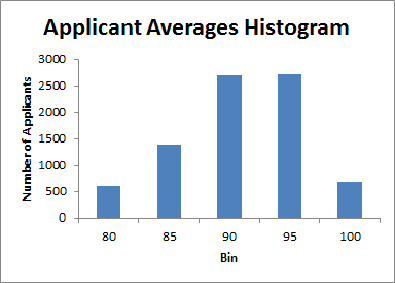 (How to read a histogram: the left bar labelled “80” shows the number of applicants with admission averages of 80 and less. The next bar shows the number with averages of over 80 to 85, etc.) . The total number of applicants is about 8,000, but there are only about 1,500 spaces, so how to decide?
Clearly the ones in the “80” group are probably not going to get an offer, and the ones in the “100” bin probably are, but what about the large mass in between? Most people agree that an applicant with an 93% average is probably not significantly “better” than one with an 89% average, given some randomness in grading practices. So that’s where our Admission Information Form (AIF) attempts to provide a way to “differentiate” between applicants by providing additional “points” to be added to the admission average. Some past posts have discussed what’s in the AIF, such as this post, as well as how it is reviewed and scored.
The AIF has helped to give applicants with slightly lower averages a better chance at an offer, but it could be better. So this year, as described on the Waterloo web page, we’re trying some additional bonus points to help identify applicants who are academically strong but also have qualities that might help them excel in Waterloo’s co-op program. Specifically, the AIF is still given an overall score (from 0.5 to 5) but additional points may be added for things such as:
- Heavier academic load. Taking more than the usual number of grade 12 academic courses during the academic year shows some ability to handle the significantly increased load in university. In Ontario, this would translate into taking 8 U/M courses during the current school year (not including summer school, or fast tracking courses in prior years). Note that taking extra courses but not doing well in them would be a negative factor.
- Applicants who show better than average “employability”. This would typically be prior summer or part-time work experience, or significant unpaid volunteer experience that would be attractive to employers. Our data indicates that students with better “employability” have an easier time getting their first co-op job, and so we would like to encourage or promote this.
- Significant achievements. These would be national or international level awards or very high results in competitions (say top 10% at a national level). Sometimes an AIF may be only “average” overall, although there are significant achievements highlighted, so we will flag these as separate items. This will likely be fairly rare.
- Participation in selected enrichment programs. These would be programs where you have to compete to be selected and are more than just a few days in length. The Shad Valley program is a prime example, although we will consider others on a case by case basis.
- Any other “unique” experience or attributes, such as entrepreneurial experience. It’s hard to say what this might include, but it’s up to the reviewers to identify people with something unique that would help them be successful at Waterloo. The large majority of applicants will not have this.
So those are a few new factors that might help some applicants stand out a bit higher in the rankings compared to just using the admission averages alone.
(Note: comments are welcomed, but I can’t give opinions on specific situations and whether they would get any bonus points. That’s up to the reviewers, not me.)
Admissions 2015: How it’s going to work
Here is an update on past years’ very popular post, with some revisions and clarification for the upcoming September 2015 admissions cycle.
Here is an overview on how the process is going to work and the approximate timelines. As usual, this is specific to Waterloo Engineering admissions; other programs and universities will have their own unique variations. Also, make sure you look through our admissions webpages for exact deadlines and official requirements since this is just an unofficial, quick overview and I can’t cover every detail for every variety of applicant and situation. Continue reading
The Most In-Demand (And Aging) Engineering Jobs
The Most In-Demand (And Aging) Engineering Jobs.
Our Dean of Engineering, Prof. Pearl Sullivan, pointed out this interesting article from Forbes magazine. Much of the information I’ve seen before in various places, but it’s a nice compilation and summary. Also, it’s based on U.S. statistics, so it’s hard to tell how the Canadian situation may compare but the general ideas are likely similar. There are a few things to point out:
“Industrial Engineering” seems to be in big demand. At Waterloo, this would roughly correspond to our “Management Engineering” program.
I’m disappointed that my discipline, Chemical Engineering, was lumped into the “All Other Engineers” category! I guess this also includes Biomedical, Software, etc.
One of the problems with these surveys is that various groups use different classification schemes for the various disciplines, and they don’t always correspond to the name of the university or college program. For example, “Aerospace Engineers” in this article probably refers to the job title, which could be filled by people with mechanical, mechatronics, or other degrees. Likewise a “Petroleum Engineer” may be a chemical or mechanical engineering graduate. Just something to keep in mind.
Admission Pressures
Many people are aware that the competition to get into engineering programs has been rising in recent years. This is often seen in the rising admission averages required to get an offer, due to this increased level of competition. Although many people acknowledge this, they may be surprised at some of the numbers so I’ve compiled some graphs to help visualize it. First, let’s look at application numbers to engineering programs. Continue reading
Preparing for the OUF
The Ontario Universities’ Fair (OUF) is coming up next weekend (Sept 19-21), and the admissions staff have been busy preparing. There are travel and hotel arrangements, training of volunteers, and all sorts of other things to do. The OUF is held in the Toronto Convention Centre, and all Ontario universities have people there to meet with prospective students, parents, etc. There is a website with more information. Continue reading
Early Offers 2014
A revised and updated version of a post from 2013.
We just finished (February 20) processing our first round of offers for applicants who are Ontario high school students, and they have been posted in Quest. It may take a few more days for OUAC to be updated and emails to go out. Some of the processes were described in an earlier post, How to Get an Early Offer (which may be a bit outdated for 2014). But to summarize, we took the data we had at that point and made enough offers to fill up to 1/3 of our available spaces in each program (more specifically, those spaces reserved for Canadians and Permanent Residents). These are applications where we have enough data and it’s clear that they are competitive, based on previous experience. We were quite conservative this year, and gave out fewer offers than in 2013, since we want to leave lots of spaces for a fair competition in the final round in May. In part, this is because application numbers are up significantly again this year and it’s hard to distinguish fairly between applicants when there are so many with similar grades. So we think it’s better to hold off until the most complete data is available in late April. We’ll be processing some non-Ontario applicant offers in the coming weeks.
Some universities give out a lot more earlier offers, but that’s simply because they have a lot less competition for spaces and can just go ahead with whatever they have. Continue reading
Random News
I have various posts in mind, but not much time to write lately. So here are just some random things that are going on.
- March Open House: we’re busy planning for our open house event on Saturday March 1, when applicants and others (like Grade 11 students) can visit, have a look around, and talk to students, staff and faculty. In previous years we held this on a Tuesday during the Ontario high school March break, but it has become too big (traffic and parking!), so it’s been moved to a Saturday this year.
- A couple of weeks ago I visited St. John’s NL on research-related business. I also took the opportunity to meet with a few of our engineering applicants and their parents. It was nice to meet with people who wouldn’t usually be able to visit us in Waterloo. I like Newfoundland; beautiful land and nice people.
- Our new Biomedical Engineering program has had an overwhelming response. There are over 10 applicants for every available space, so I suspect that it will be our most competitive program for admission this year.
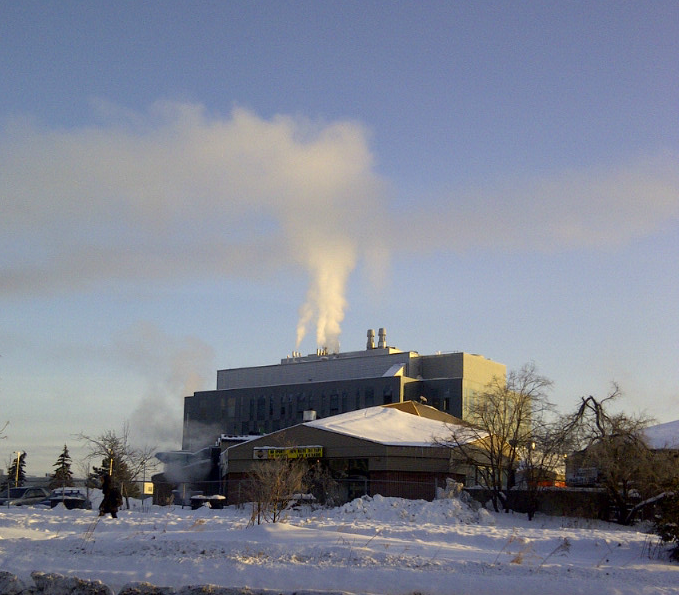
- Since I teach air pollution control, I’m interested in meteorological phenomena. So here is a picture of a radiation inversion from the other day. You can see the vent emissions from our Engineering 6 building rising vertically, then hitting the inversion layer and moving horizontally. Inversion layers inhibit vertical mixing. I’ll use this in my lecture next year.
- Applications to Waterloo engineering are up significantly this year, which is putting a strain on our systems. We’ll have to ask for people’s patience as we work through all the materials and decision-making processes. The bulk of our decisions will come out in early May, as usual, even if we have to work 24/7 to do it!
- We’re currently working on Ontario student (OUAC Form 101) round 1 decisions. Hopefully we’ll have some decisions going out by the end of this week (although sometimes the process gets hung up and delayed).
 A Professor in Waterloo Engineering