Engineering Most Popular Degree Among Millionaires

Here is an interesting article.  If you follow the link at the bottom for the rest of the article, it goes on to say that most engineering millionaires made their fortunes as entrepreneurs. 

Engineering Most Popular Degree Among Millionaires

Posted on November 18, 2013 by admin

by Marc Howefrom Sourceable 14th November 2013

A new survey has found that an engineering background produces more millionaires than any other form of tertiary instruction.

The survey, conducted by wealth management publication Spear’s and consulting firm WealthInsight, found that engineering was the most popular degree amongst the world’s millionaires, beating out even MBAs and computer science and finance degrees.

MBAs came in second after engineering, with economics, law and business administration degrees rounding out the top five. While engineering was at the top of the list, the only other STEM subject represented in the top 10 was computer science, logging in at number eight.

Other disciplines common among the world’s millionaires included commerce, accounting, politics and finance.

via Engineering Most Popular Degree Among Millionaires – Australia Wide Personnel.

Comparing Biomedical Engineering Programs

Choosing a Biomedical Engineering (BME) program is a bit more complicated than many other programs, like chemical or mechanical, because there is actually quite a variety among them.  The following is my impression of the various types of BME programs.

First, what should a Biomedical Engineering (BME) program look like academically?  Here is a reasonable definition given by ABET, the U.S. “Accreditation Board for Engineering and Technology“:

The program must prepare graduates to have: an understanding of biology and physiology, and the capability to apply advanced mathematics (including differential equations and statistics), science, and engineering to solve the problems at the interface of engineering and biology; the curriculum must prepare graduates with the ability to make measurements on and interpret data from living systems, addressing the problems associated with the interaction between living and non-living materials and systems.

(The Canadian equivalent of ABET, CEAB, doesn’t publish any definitions but our expectations would be similar anyways.)

Within that framework, there are actually several different “flavours” of BME, and for potential applicants it is very important that you recognize and understand this.  Otherwise, you might end up in a program that is completely different from what you might have had in mind.  Here, I will attempt to summarize my understanding of the different “flavours”, with some example programs in Canadian universities. Continue reading

Biomedical Engineering Starts Here

Exciting news for those who have been asking about Biomedical Engineering at Waterloo!  All the necessary internal and external approvals have been received and we are launching an undergraduate (B.A.Sc.) program in September 2014.  So the OUAC application centre should now be able to take applications to this program.

A prosthetic eye, an example of a biomedical e...
A prosthetic eye, an example of a biomedical engineering application of mechanical engineering and biocompatible materials to ophthalmology. (Photo credit: Wikipedia)

I’ll provide some brief details about the program below, and then some more detailed thoughts and comparisons in future posts.

  • Like all of our engineering programs, this one will have program-specific courses right from the first day, and will be a mandatory co-op program (alternating 4 month periods of academic and industry work experience).
  • This will be a modified Stream 8 program (i.e. the first co-op job starts at the end of 1st year, after 8 months of academic study).  One unique feature is an 8 month workterm between 3rd and 4th year, followed by eight months of academic work.  This gives more time to focus on one work term job, and more time to focus on a major design project in 4th year.
  • The Biomedical Engineering program is a joint undertaking with input and teaching by several departments including Systems Design Engineering, Electrical and Computer Engineering, Mechanical and Mechatronics Engineering, Chemical Engineering, Biology, and the School of Anatomy.  It pulls together a lot of biomedical engineering expertise that already exists across those departments.
  • The curriculum was designed with significant input from industry and graduate schools, so it should be very relevant for either path.
  • Admission requirements:  same course requirements as all of our other engineering programs. (in Ontario, ENG4U, SPH4U, SCH4U, MHF4U, MCV4U, + one other U/M course).  High school biology is not required.
  • Grade requirements?  Hard to say, because that depends on the level of competition (i.e. number of applicants and their grades).  There are only 45 spaces available in 2014, so we are guessing that mid to high 80’s might be necessary but it could go higher or lower.  If you are interested, just apply and see what happens.
  • Another unique feature:  the program provides the opportunity to focus in a couple of interesting areas, namely Neuroscience and Sports Engineering.
  • It is expected that there will be significant interactions with Waterloo’s Department of Kinesiology, as well as the Schools of Computer Science, Pharmacy, Optometry & Vision Science, and the Centre for Theoretical Neuroscience.  A lot of biomedical research already takes place at Waterloo, as brought together in our Centre for Bioengineering and Biotechnology, so there should be opportunities for students to work on research projects (as there are with all of our programs).

There are other details I will cover later, but let me know in the comments if there are specific topics or questions I should try to address.

Calculators I’ve Known and Loved

Here is a stereotypical, nerdy engineering reflection on calculators.  Actually, the purpose is to illustrate how much technology changes in a single generation, and maybe somebody will find it interesting. So, here is a brief description of calculators that I have used in university and beyond.

Slide Rule

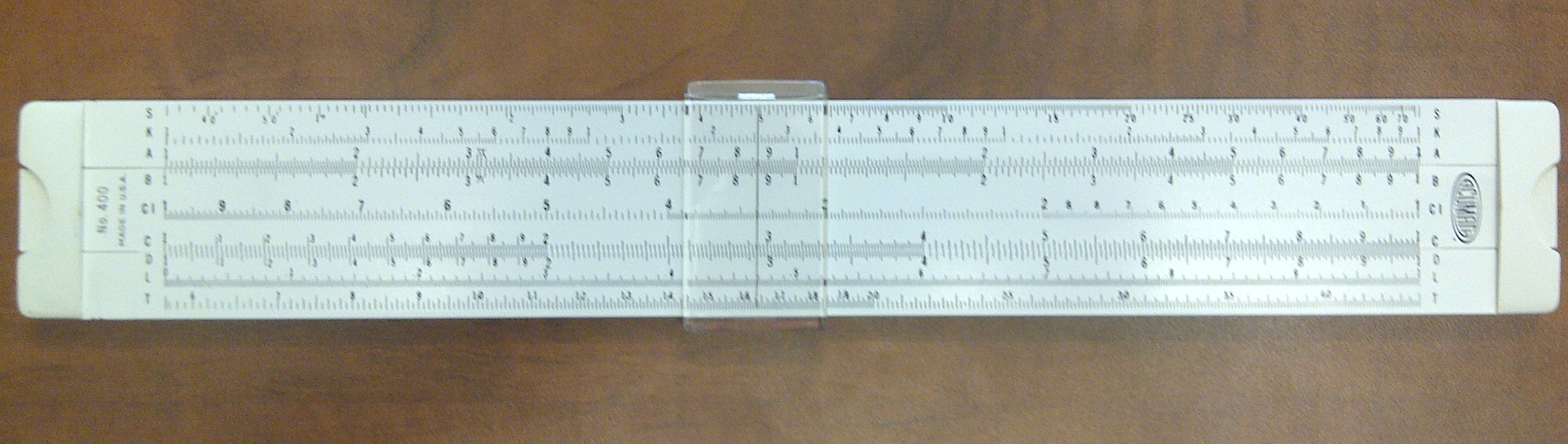
  Acumath slide ruleYes, I actually used this in high school and for the first couple of weeks of university in my chemical engineering program (for reasons you’ll see below).  Once you were proficient, it could be faster than a calculator for some calculations.  The downside is that you can’t add or subtract with it, only multiply, divide, do logarithms and trig functions.  Addition and subtraction you have to do in your head, or on paper.  It’s interesting to think that most engineering design done prior to the early 1970s was based on slide rule calculations. Continue reading

A Sample Co-op Experience in Chemical Engineering

Here is a story about one of our Chemical Engineering students, and some of his work term experiences in the petrochemical industry.  It’s typical of the variety of things that our students do during their 6 workterms over the course of our program.A Shell and Tube heat exchanger

by Shannon Tigert. A version of this piece originally appeared in the Spring 2013, ed. 2 issue of the Inside sCo-op newsletter.

Brodie Germain (4A Chemical Engineering) spent two rewarding co-op work terms at Suncor Energy. With his first two co-op jobs completed elsewhere, he was hired for his third work term as an Environmental Health and Safety Intern at Suncor’s wastewater treatment plant at the Mississauga Lubricant Facility. In this position, Brodie sampled the water the plant was using to ensure it was within government regulations.

Brodie’s position in his subsequent term at Suncor was Technical Services Intern, a support role for different engineers in the department. Each engineer is responsible for a different section of the plant, and by assisting all of them Brodie gained a variety of experiences.

A major project of Brodie’s during this term was a management of change analysis involving a heat exchanger problem; fluids passed through tubes to be heated and cooled. One of the fluids was picking up too much heat, reaching dangerously high temperatures. Various concerns and issues needed to be addressed, but Brodie appreciated the challenge. That’s because he connected what he was learning with things he had already done in school, like hydraulic calculations, collecting drawings and data sheets, and using logical thinking. Doing this kind of work was “as relevant as it gets” to his engineering degree, says Brodie: “I was able to find my strengths and weaknesses while developing my communication skills and technical foundations. A solid technical skills foundation is the most important practical thing to have as an engineer.” Continue reading

Why Do We Care About High School English?

Although Grade 12 English (or something equivalent) is one of our admission requirements, we sometimes get applicants who question what it’s good for, and why should it hurt their chances of admission if they got low marks in that subject.  After all, engineering is just about physics, calculus, problem-solving, writing code, designing bridges and other hardware, …, isn’t it? Continue reading

UW Engineering Shadow Program

This is a great way to experience Waterloo engineering…well worth a day off school.

Engineering Girls at University of Waterloo

For those of you who are considering UW Engineering, have you heard about the UW Engineering Shadow Program? It is handled by the Engineering Student Ambassadors Team and we would love to spend a day with you for you to experience a day at the University of Waterloo as an Engineering student.

The days available are typically from 8:30AM to 4:30PM from Mondays to Fridays. There are students available from all engineering programs and you may request a specific ambassador although it will depend on the ambassador’s availability. You can find the profiles of our ambassadors here.

Shadow days for the Fall term (September-December) are reserved for grade 12 students only. Starting in the Winter term through Spring/Summer (January-July), shadow days will be available to grade 11 and 12 students.

If you are interested, definitely register now. It will be a great…

View original post 9 more words

Comparing Software to Computer Engineering

Another installment from Prof. Patrick Lam, the Associate Director of Software Engineering.  A previous one compared Software Engineering to Computer Science. With these various posts, you should have a good overview of the differences and many similarities between the three programs. Note:  for Waterloo you can only apply to one of Software or Computer Engineering.  If you’re interested in Computer Science too, you need to submit a separate application for that program.

Comparing the BSE in Software Engineering to the BASc in Computer Engineering

Summary: Waterloo’s Software Engineering (SE) and Computer Engineering (CE) programmes are both CEAB-accredited Engineering programmes. After the first year (which is quite similar), Software Engineering takes a deeper and more Computer Science-centric view of the material and focuses less on hardware, while Computer Engineering provides a broader overview of material and includes more hardware content. You must have experience with writing programs to be admitted to (and to succeed in) Software Engineering.

Employment outcomes from SE, CE, and Computer Science (CS) are broadly similar. What you get out of a university education depends less on your specific courses and more on what you put into your courses, your interaction with peers, and your work experience. However, the programmes do differ. To help you choose which programme is the best fit for you, here are some of my personal observations about culture and courses. Continue reading

What do engineers actually do?

Some great real-life examples of what an engineer might do!

life as a woman in engineering

We solve problems… like…

Why is a factory conveyor breaking annually when it was designed to last 10 years? Is the same part failing every time? Is the part defective? Or is there a design flaw? Is it run and maintained correctly?

How thick should the glass be on the on the latest, greatest smartphone? Consider tradeoffs across multiple design parameters including drop tests, cost, weight, manufacturing capability, and clarity.

Customers are returning appliances all made between March and June for a burnt plastic odor. What is the source of the odor? Are all the products leaving the factory today going to have the same problem? Or was it confined to a single lot? What countermeasures can be put in place to eliminate the problem?

A plastic extrusion process is consuming 50% more energy in one plant compared to another. Figure out why and reduce energy usage.

Use stress analysis…

View original post 322 more words