Waterloo does well in PitchBook entrepreneurial rankings

The following is re-posted from Waterloo’s Daily Bulletin website.  Interesting statistics for those who are interested in entrepreneurship.

Ranking season is upon us as organizations have begun publishing their annual listing of international universities.

The PitchBook 2017/2018 Universities Report is the latest to be released. PitchBook compiles a ranking of the world’s top 50 universities that produce venture capitalist-backed entrepreneurs.

This year, the University of Waterloo is ranked #20 in the world for the number of VC-banked entrepreneurs, and is the highest-ranked Canadian university, with the University of Toronto coming in at #31, McGill University at #32, the University of British Columbia at #49 and Queen’s University at #50. This measure ranks universities by most prolific producers of entrepreneurs with venture capital banking and includes companies that received a first round of venture funding between January 1, 2006 and August 18, 2017. Waterloo counted 390 entrepreneurs and 299 companies raising $7.06B. Waterloo’s rank remains unchanged from last year.

In the category of top universities for “unicorns,” or the number of entrepreneurs founding companies that are valued privately at $1B or more, Waterloo is tied for fourth place (and again, #1 in Canada), with only Stanford, Harvard, and Cornell ahead of us. Waterloo is tied with the University of California at Berkeley. Waterloo’s top unicorns included Wish, Pivotal Software, Kuadi Dache, Instacart, and Storm8. Waterloo moved to fourth place from sixth place last year.

In the category of top companies by capital raised, Waterloo is ranked #20 (1st in Canada), the same rank it achieved last year. Waterloo-connected companies listed in the ranking included Wish; Pivotal Software; Kuaidi Dache; Instacart; and Storm8.

Source: Tuesday, September 12, 2017 | Daily Bulletin | University of Waterloo
Chances for 2018

To start the new academic year and next admission cycle, the 2018 Admissions brochures for Engineering and other programs have recently been uploaded on the Waterloo website.  We continue to include a table showing admission probabilities (“chances”) for different programs and grade ranges (at the end of the brochure, and another online version is available here).  Many people find it useful for assessing  their chances at admission, and  then they can plan accordingly and have realistic expectations.   This is based on the 2017 results and as usual we caution that 2018 may be different, since it all depends on the number of applicants (which is unknown in advance and can fluctuate).

For convenience and readability in a table, we lump the grades into ranges.  Some people find the big jumps in probability between the different grade ranges to be difficult to understand or interpret, so I have been generating graphs that provide interpolations between the various grades in finer detail (see the end of the post for methodology, if interested).  As usual, the grades shown below are the raw, unadjusted averages of the Grade 12 required courses (or equivalents), not including any other factors such as scores for extracurriculars, work experience, or awards. Continue reading

So, about this Googler’s manifesto. – Yonatan Zunger – Medium

Anderson:  Ignoring the underlying controversy for the moment, I found these excellent two quotes about the nature of engineering work.  I would say it’s applicable to every engineering discipline, beyond just software.  Very useful concepts for high school students to understand if they are thinking about an engineering career.

Engineering is not the art of building devices; it’s the art of fixing problems. Devices are a means, not an end. Fixing problems means first of all understanding them — and since the whole purpose of the things we do is to fix problems in the outside world, problems involving people, that means that understanding people, and the ways in which they will interact with your system, is fundamental to every step of building a system.

—————

Essentially, engineering is all about cooperation, collaboration, and empathy for both your colleagues and your customers. If someone told you that engineering was a field where you could get away with not dealing with people or feelings, then I’m very sorry to tell you that you have been lied to. Solitary work is something that only happens at the most junior levels, and even then it’s only possible because someone senior to you — most likely your manager — has been putting in long hours to build up the social structures in your group that let you focus on code.

Source: So, about this Googler’s manifesto. – Yonatan Zunger – Medium

What U.S. Campus is Most Like Waterloo?

In a recent post about rankings, I showed that Waterloo often appears in the rankings alongside colleges like Penn State, Texas A&M, Purdue, UCLA, Michigan, etc.  So perhaps the next question is, “how does Waterloo look and feel compared to these or other colleges?”.  Rankings are one thing, but if you don’t like the environment then the ranking probably doesn’t matter.  By “look and feel”, I mean the general campus environment (architecture, space, etc.) and situation (urban, suburban, rural, etc.).  Waterloo is a fairly young university (just 60 years old this year), located within a medium sized city (population about 380,000 if you combine the twin cities of Waterloo and Kitchener), so how does that compare with those places? Continue reading

Rough waters turn to smooth sailing for student team

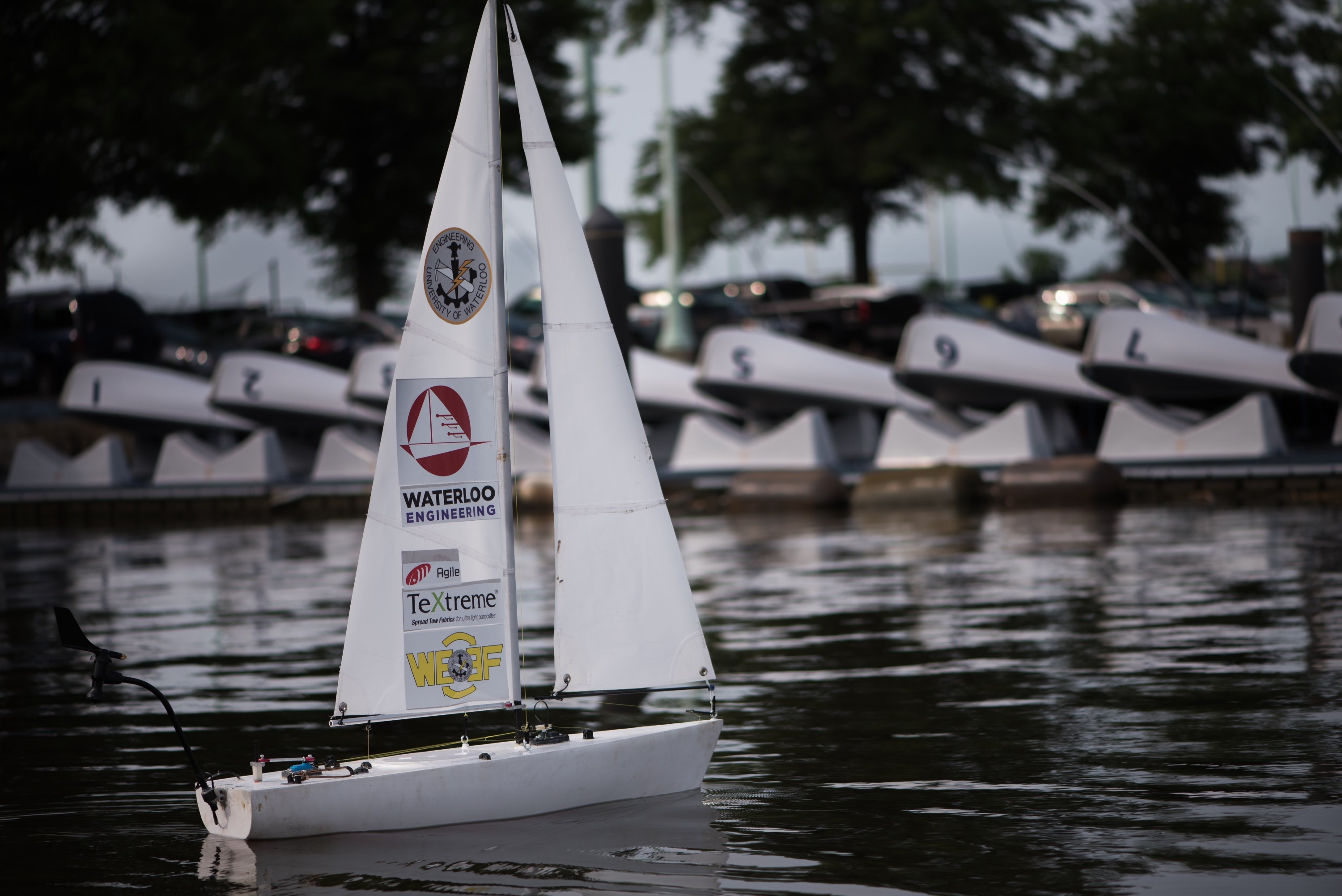
UWAST’s autonomous sailboat in action

Anderson:  I didn’t know we had a robotic sailing team!  I learn something new every day. 
Source: Rough waters turn to smooth sailing for student team | Engineering

By Nancy Harper

The University of Waterloo Autonomous Sailboat Team (UWAST) may be new to robotic sailing, but like every hardworking engineering team with one eye on the horizon, its goal is to win, not just compete.

That mindset served UWAST well in June at the 2017 International Robotic Sailing Regatta in Annapolis, Maryland.

UWAST team members Seamus Johnston, Richard Li and Jessen Liang are congratulated by event chairman Paul Miller (left).

With five main challenges over five days, UWAST members proved they were up to the task of facing seasoned veterans. The team finished sixth overall — not bad for a university that had entered this kind of international competition just once before in 2006.

Team leads Richard Li and Seamus Johnston were joined by Lily Liu, Jessen Liang, Jonathan Parsons, Chris Carnduff, Trevor Van Leeuwen, Dominic Faryna and Julian Howarth, plus faculty advisor Professor Jan Huissoon.

Representing the full spectrum of engineering – from mechatronics and mechanical, to electrical and chemical – members are optimistic they set the stage in Annapolis for future success. Continue reading

Water Testing: From Research to Kickstarter

One focus of my research group’s efforts over the past 10 years has been collaborative R&D with small and start-up companies.  They often have some very interesting ideas and needs, but lack the facilities and technical team to do the work in-house.  So this is a perfect opportunity for us to help them out with creating new businesses and for my students to get some “real-world” research experience with commercialization projects.

One major effort has been in the development of nanotechnology for rapid water quality testing, in particular for bacterial contamination.  Traditional laboratory methods require 3 to 7 days to complete, which is a rather long time to wait if you’re concerned about your water quality.  Through our collaborative R&D projects, we’ve developed a test method that can give an answer in a few minutes.  This rapid feedback allows people to make informed decisions about what to do next, whether to treat the water further, or send samples to a lab for more extensive testing, etc.

2089771938b2425c496dfb544482211e original

Prototype ExactBlue water testing system.

One recent development is the creation of a more automated, smart-phone based system that’s suitable for regular consumer use.  A prototype model is shown in the photograph.  We’ve been testing the prototype devices with our nanotechnology-based reagent (which goes into the test tube), and doing validation and calibration work.  Everything is looking good and everyone has been pleased with the results.  It’s reliably and quickly detecting microbial contamination in our water samples, and there are some other water tests under development that will be able to use the same platform.

To get to the next stage, which is production of the first batch of devices for sale, the company has just launched a Kickstarter campaign.  Have a look at their Kickstarter website to see much more information about the technology and where they are headed.

Waterloo’s Ranking Neighbours

I (and many others) don’t put a lot of confidence in rankings as a useful tool for high school students in selecting universities, but people tend to look at them and debate nevertheless.  The problem is, there are so many rankings available with different criteria and methodologies.  How do you make any sense of it?

Recently, I was reading about a statistical analysis technique called nearest neighbour analysis, and it gave me the following idea.  Why not look at several ranking system results for Waterloo and see if there is any commonality in the universities that are ranked around the same level?  So, I looked at the most recent Engineering rankings from QS, Times Higher Education, US News, ARWU, and URAP, and focused on just universities in North America.  I looked at Waterloo’s position, and the next 10 ranked above and below.  The result is shown in the following table, where the number in parentheses is the global rank… Continue reading

University of Waterloo students make a big splash in the 2017 AquaHacking semi-finals | Water Institute

An interesting competition event showcasing environmental water quality innovations by student groups.  Sponsored by the Water Institute at Waterloo, one of the research centres I belong to.

The AquaHacking 2017 semi-final competition unfolded last week at CIGI. By the end of the evening, five teams were chosen to move on to the final competition at Waterloo on September 13. It was a difficult decision for the five judges, as all 17 teams that competed offered innovative ideas that tackled the challenges and opportunities facing Lake Erie.

Source: University of Waterloo students make a big splash in the 2017 AquaHacking semi-finals | Water Institute

Getting to Know Failure

A while ago I came across Prof. Haushofer of Princeton University and his CV of Failures.  It was interesting, and kind of funny if you look at the last entry.  It also reminded me that professors are usually experts in failure, and not because we fail some of the students in our courses (although that does happen).

One of our Engineering Counselors once mentioned in a meeting that many students (especially new students) regard professors with a certain amount of awe and believe that we can do almost anything successfully.  But sadly no, most of us could probably also write a similar long list of “failures”.  These lists would include things such as jobs and promotions we didn’t get, research grants competitions we didn’t win, equipment funding that was denied, awards we didn’t receive, journal manuscripts that were rejected, cool research ideas that didn’t work, research collaborations that fell apart, graduate students we’ve mentored who didn’t excel, teaching innovations that flopped, courses and lectures that didn’t go very well, etc, etc.

Professors are actually so well acquainted with “failure” that we normally don’t even think much about it…it’s just a routine part of the job and life in general.  It’s so routine, we sometimes forget that it’s probably a new experience for many first year university students, when they get a failing grade in an assignment or test, or they don’t get the co-op position they were hoping for.

One can read in various publications about entrepreneurs and business people and their long list of failures before finding something that actually works.  For example, there are a few stories in the University of Waterloo Magazine about some alumni and their experiences with failure.  I guess that the bottom line is that “failure” is a normal part of adult life in pretty much any field.  The trick is to just expect it, embrace it, learn from it, and move on to the next thing.