We continue looking at some admissions data for some Ontario engineering programs, based on the CUDO public database. As a bit of background, applicants to Ontario universities all apply through a central system (OUAC) shared by the universities (which is where this data comes from, I assume). In this system, an applicant can rank their preferred choice of program and university. Presumably, applicants rank as first choice the university they most desire to attend. Let’s see from the data where people tend to want to go, and how many end up there after the admissions process is all done.
Continue readingEngineering Education
Entrance Average Breakdowns
In a recent couple of posts we’ve looked at the overall entrance averages for some Ontario engineering programs, and the specific proportion of admitted students that had a 95%+ average. Let’s look at the full breakdown of the proportions of admitted students with averages of 75-79, 80-84, etc. This data gets a bit too messy to plot across several years, so I’ll just look at 2021, the most recent year available on the CUDO data website.
Continue readingAdmitted With a 95%+ Average
The previous post showed the overall averages of students admitted to engineering programs (based on CUDO and Ontario school data). Since CUDO provides the data broken down into grade range bins, let’s look at one in particular. This is the bin for admitted students with an admission average of 95% or higher. The graph below shows the proportion (%) of admitted engineering students that had a final admission average greater than or equal to 95%, from 2017 to 2021 (the last available year)
Continue readingEntrance Average Trends
Everyone is always excited, concerned, interested and/or complaining about entrance averages, whether your a potential applicant, parent, faculty member, secondary school teacher, accreditation board, etc. So let’s have a look at how Ontario engineering school entrance averages have faired over the past few years. As usual, the data is from CUDO and in this case it is only available up to the 2021 entrance.
Continue readingWomen in Engineering Trends
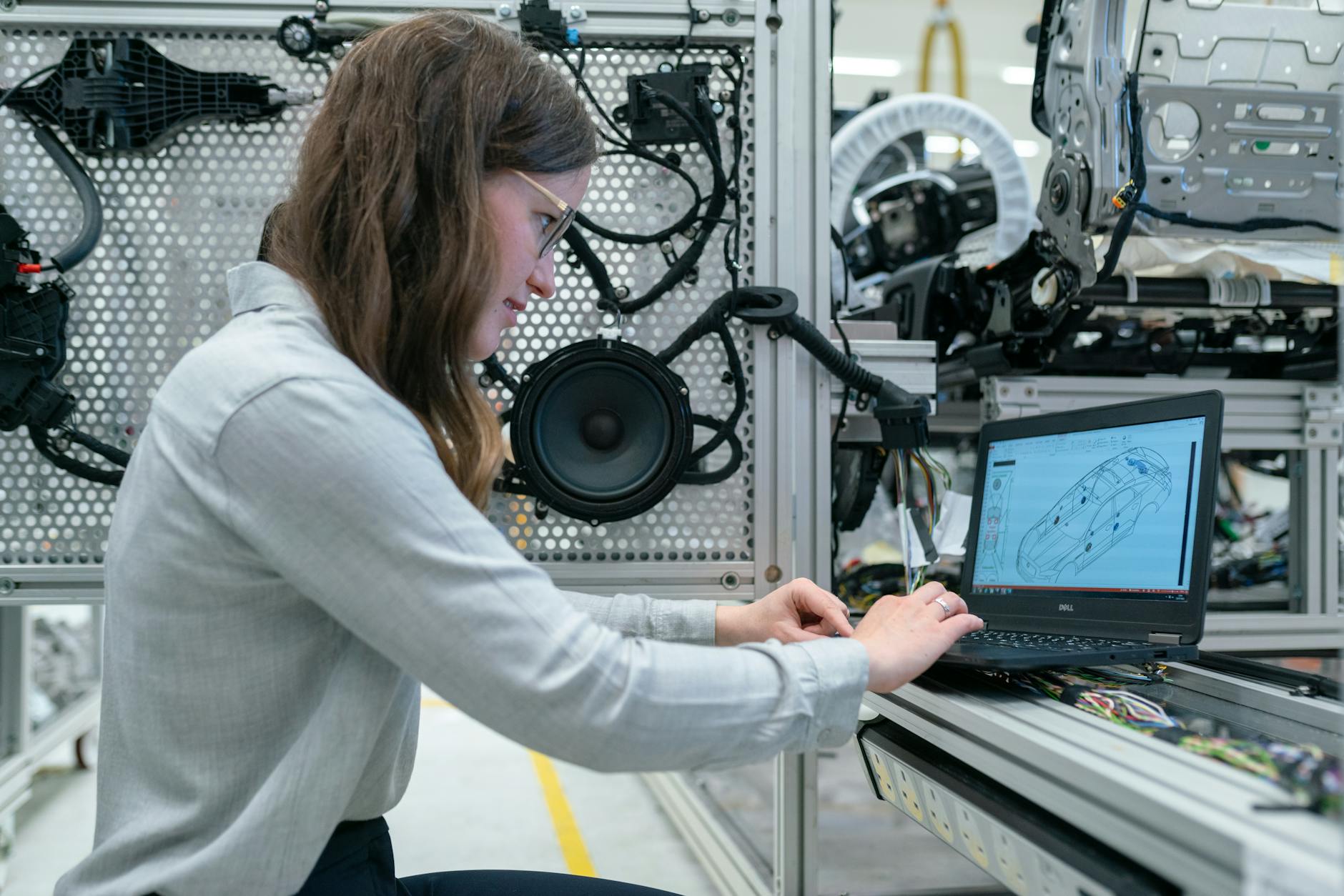
The Common University Data Ontario (CUDO) website has lots of accessible information about Ontario universities, and it’s been quite a while since I looked at it. Since there’s nothing more fun for engineers than compiling and looking at data, I’ll post some now and then. Today, let’s start by looking at female, full-time enrollment in some Ontario engineering programs, and how it has trended over the past few years.
Continue readingAccreditation Requirements: The Process
Previously in this series, I’ve summarized the why and what (content & outcomes) for engineering program accreditation. Let’s finish up with how it all works; what does an engineering program have to do to be accredited according the the criteria discussed previously?

First of all, the frequency. Engineering programs are accredited for at most 6 years (sometimes less if there are some concerns raised by the Canadian Engineering Accreditation Board, CEAB). So every 6 years the cycle described below is repeated for every engineering program in Canada (although not all in the same year!). For new engineering programs the cycle doesn’t start until the first students are graduating.
- The institution requests CEAB to assess or re-assess their engineering programs. Often, they try to do all the programs at the same time to save on time and effort.
- A visiting team is put together for each program, consisting of professional engineers familiar with that discipline. Typically there is a mix of faculty from other universities and people from industry.
- The institution puts together a tremendous pile of documentation for each program, which is sent to the visiting teams. This documentation provides evidence in support of each program’s content and outcomes described in the previous posts. The materials often include:
- Overall descriptions of each program, the structure, required and elective courses
- Descriptions of how admissions to the programs are handled (I had to deal with this in the past)
- Descriptions of facilities, student supports, etc. at the program level and higher.
- Financials for the programs, including investments in facilities and student support.
- Details on faculty, who teaches what courses, and whether they are licensed engineers.
- Details on each course in the program, its content, who teaches it, the course learning outcomes, how the outcomes are evaluated, typical class averages, and typical failure rates.
- Evidence for how the program meets the content criteria
- Evidence for how the program meets the expected accreditation outcomes
- Evidence and results for how the program continuously gathers feedback from graduates and industry to help implement continuous improvement of the program.
- The visiting teams review the documentation in advance, and then spend about 3 days at the institution to review the programs, facilities, personnel, in person. This will typically include:
- Interviews with students in each program
- Interviews with faculty teaching each program
- Interviews with the Dean and various other administrators for programs and the university
- Tours of the teaching facilities, labs, student workspaces, etc.
- Examination of teaching materials, such as course syllabi, textbooks, course notes, examples of student work such as assignments, reports and exams (both good and bad, but anonymous), projects completed by students, student transcripts (anonymous).
- After the visit, the teams compile reports which are sent to the CEAB for final decisions about whether accreditation will be granted, and/or for how long (i.e. 6 years, or less). The institution gets a copy of the reports and can respond to any inaccuracies in the report, or any weaknesses highlighted by the teams. These responses are also considered by CEAB before their final decision.
Ideally, the program gets a 6 year accreditation if there are no major concerns raised by CEAB. Then, after 6 (or whatever) years, the whole cycle starts again. At Waterloo, it’s an ongoing process during the 6 year period to continuously gather information that will be needed for the next accreditation cycle, so it never really ends. For example, when I teach a course I have to map the course content to the expected accreditation outcomes.
So, accreditation is a huge undertaking requiring a lot of documentation, information-gathering, planning, and visitor scheduling. This involves a lot of faculty and staff hours, and there are staff positions in Engineering that are largely dedicated to this process. I’ve never seen an estimate for how much this costs the Engineering programs, but I imagine it’s not cheap! Another factor that leads to engineering being a more expensive program to deliver, and so having higher tuition rates for students.
Accreditation Requirements: Outcomes
In this series I’ve covered why accreditation of engineering programs is important, and what the programs should contain. However, it’s not enough to just have the right program content. The programs have to also achieve a long list of “outcomes”, meaning that students graduating from the programs should have the following attributes:
- Engineering knowledge base: competence in math, sciences, engineering fundamentals, and discipline-specific knowledge.
- Problem analysis: ability to use the knowledge to solve engineering problems and make substantiated conclusions.
- Investigation: ability to approach complex problems using experiments, data analysis, and synthesis of information.
- Design: ability to meet goals and make decisions for complex, iterative and open-ended problems using all the tools available, including health & safety, sustainability, economic and other constraints.
- Use of engineering tools: ability to create, select or extend techniques and methods to solve problems, while understanding the limitations of these tools. This is often software & calculational tools, but can include other stuff.
- Individual and team work: ability to work as a member and leader in teams, preferably multi-disciplinary.
- Communication skills: ability to communicate complex engineering concepts to other engineers and the broader society. Includes reading, writing, speaking, listening, comprehending and writing effective reports & design documentation.
- Professionalism: understanding the roles & responsibilities of professional engineers, especially in protecting the public.
- Impact of engineering on society and the environment: understanding the interactions between engineering and societal effects such as economics, health & safety, legal, cultural, sustainability, environmental.
- Ethics and equity: ability to apply professional ethics, accountability and equity.
- Economics and project management: incorporating economics and business practices, including project, risk and change management, and knowing the limitations.
- Life-long learning: ability to identify and address personal educational needs to maintain competence in the field.
So everyone graduating from an engineering program should have achieved these attributes at some reasonable level, recognizing that they are just beginning a career and will continue to develop skills. In the next post, we’ll look at the actual accreditation process and how programs have to demonstrate that they have the right content and that their graduates have all the required attributes.
Accreditation Requirements: Content

In a previous post, the meaning and impact of an engineering program accreditation was discussed. Here, let’s look at what sorts of things an engineering program has to show or contain to meet the minimum accreditation requirements. These requirements are contained in the rather arcane CEAB document “Accreditation Criteria and Procedures” available online. I’ll try to summarize the highlights of this document, although there are a bunch of small details and sub-criteria that I will not get into.
Curriculum Content
All engineering programs must contain certain content, broadly speaking. Roughly (showing minimum percentages of the total program hours) programs must include:
- Mathematics (>10%) including linear algebra, calculus, probability, statistics, numerical analysis.
- Natural sciences (>10%) including some physics and chemistry, and possibly life sciences & earth sciences.
- Engineering science and design (>50%). “Engineering science” includes application of math & natural science to practical problems, materials, fluid mechanics, electronics, environmental science, and others specific to the discipline. “Engineering design” involves the process of decision-making to devise products, processes, components, etc. to meet specified goals, which typically include considerations of health & safety, sustainability, economics, human factors, feasibility, regulatory compliance, etc.
- The curriculum must finish with a significant design experience carried out under an engineering-licensed faculty member.
- Complementary studies (>12%) which must include economics, humanities & social sciences, communications, impact of technology on society, health & safety, sustainable development, professionalism, ethics, equity and law.
- The curriculum must include appropriate laboratory experience.
Not all the topics mentioned above have to be the subject of an entire course on their own, they can be parts of other courses. The specific courses and content will also depend on the engineering discipline to some extent. For example, Boolean algebra isn’t typically taught in Chemical Engineering but is in Computer Engineering and likewise organic chemistry isn’t taught in Computer Engineering but is in Chemical Engineering.
There are some other related criteria and constraints, like the minimum number of total curriculum “hours” (roughly at least 1,850 lecture hours, but it’s complicated how these are counted) and minimum splits between engineering science and design, but that covers the main points. With all these requirements, it is easy to see why engineering programs in Canada are typically very structured and have relatively few elective courses compared to many other programs in arts, mathematics and sciences.
Program Environment
Aside from the curriculum content, the engineering programs have to have a suitable “environment”. This includes the quality, morale and commitment of students, faculty, support staff and administration. The quality, suitability and accessibility of labs, library, computing and non-academic counselling must also be satisfactory. Other factors include:
- The governance structure of the programs, from the Dean down to the curriculum committees must be suitable and fully within the control of engineering faculty members, especially those holding engineering licenses.
- There must be sufficient financial resources for programs to recruit and retain qualified staff and to maintain and renew infrastructure and equipment.
- Engineering faculty must have a high level of competence and expertise, as demonstrated by
- education level
- diversity of background, including non-academic experience
- experience and accomplishments in teaching, research and/or engineering practice
- participation in professional, scientific, engineering and similar societies
- A significant portion of the faculty are expected to be licensed to practice engineering in Canada, and especially those teaching courses that involve engineering science and design (typically upper year courses and electives).
This summarizes some of the requirements, but there are actually another whole bunch called “graduate attributes”. That will have to be the subject of another post, since it’s quite long.
Selecting Your Offer
Offers to Ontario engineering programs will probably be wrapping up over the next two to three weeks (mid-May?). Then people have until some date in early June to pick the one they want (see your offer or OUAC for specific deadlines) and put down some sort of deposit. It seems like most people apply to multiple universities and programs these days. In the “old days” you could only apply to 3 in total, but I think the average now is around 5 or 6. I’ve seen some applications in the high 20’s!
So assuming you have 2 or more offers to choose from, how do you decide? Ultimately it’s going to be a very personal decision, but here are a few common factors to consider:
- Program: do you really know what it’s about, and how well it fits your interests, skills and temperament? Ignore your family and friends ideas about the “best” program for the future and jobs. It’s your future.
- Location: is quick and easy travel back home on weekends important to you or necessary for some reasons? Or, are you fine with staying away for weeks and months and connecting by Skype or whatever?
- Costs: some programs are expensive. Some cities are expensive to live in. How do the total costs add up for your budget? Is there an internship or co-op program to help with the costs, and how much does it help?
- Facilities and Extracurriculars: is there something that you really want or need to do, apart from the academic program? Does the university have that opportunity available? Are there clubs or sports opportunities that you are particularly interested in?
- Scholarships: are these important for your budget and affordability? Did you get a really big scholarship spread over 4 years? If so, are there performance conditions, such as maintaining an 80% average? Note that many students have difficulties maintaining these averages, so the scholarship may not really be that reliable for future budgeting purposes.
- Prestige: studies from the US generally show that going to a “prestigious” school has no particular influence on career (with the possible exception of politics). Ignore “prestige” or rankings and go for the place and program that is the best fit for you and your interests. An engaged and interested student will always do well wherever they are, versus a miserable student at a “prestigious” university or program.
- Other? Possibly there are some other factors that are more individual? I can’t think of any more general ones at the moment, but suggestions in the comments are welcomed.
Watching the earth move | University of Waterloo
An interesting story from one of our Geological Engineering students…
Seismically monitoring an active volcano in Spain? That’s last thing I thought I  was going to do when I first started at the University of Waterloo five years ago! Whenever the choice for a new opportunity crops up, I always ask which option scares me most. And that’s the one I choose. This has been the fundamental question I ask myself every term when choosing a co-op job, and it led me to my recent position as a seismology intern in Europe.
Source: Watching the earth move | Alumni | University of Waterloo
 A Professor in Waterloo Engineering