Programs that have many more applicants than available spaces all have one major problem. How do you “differentiate” between many applicants with similar backgrounds and academic achievements? To illustrate, here is a histogram of the distribution of grades for Waterloo Engineering in a past year. 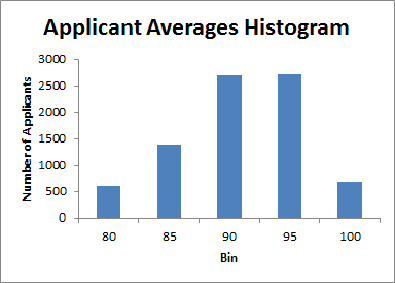 (How to read a histogram: the left bar labelled “80” shows the number of applicants with admission averages of 80 and less. The next bar shows the number with averages of over 80 to 85, etc.) . The total number of applicants is about 8,000, but there are only about 1,500 spaces, so how to decide?
Clearly the ones in the “80” group are probably not going to get an offer, and the ones in the “100” bin probably are, but what about the large mass in between? Most people agree that an applicant with an 93% average is probably not significantly “better” than one with an 89% average, given some randomness in grading practices. So that’s where our Admission Information Form (AIF) attempts to provide a way to “differentiate” between applicants by providing additional “points” to be added to the admission average. Some past posts have discussed what’s in the AIF, such as this post, as well as how it is reviewed and scored.
The AIF has helped to give applicants with slightly lower averages a better chance at an offer, but it could be better. So this year, as described on the Waterloo web page, we’re trying some additional bonus points to help identify applicants who are academically strong but also have qualities that might help them excel in Waterloo’s co-op program. Specifically, the AIF is still given an overall score (from 0.5 to 5) but additional points may be added for things such as:
- Heavier academic load. Taking more than the usual number of grade 12 academic courses during the academic year shows some ability to handle the significantly increased load in university. In Ontario, this would translate into taking 8 U/M courses during the current school year (not including summer school, or fast tracking courses in prior years). Note that taking extra courses but not doing well in them would be a negative factor.
- Applicants who show better than average “employability”. This would typically be prior summer or part-time work experience, or significant unpaid volunteer experience that would be attractive to employers. Our data indicates that students with better “employability” have an easier time getting their first co-op job, and so we would like to encourage or promote this.
- Significant achievements. These would be national or international level awards or very high results in competitions (say top 10% at a national level). Sometimes an AIF may be only “average” overall, although there are significant achievements highlighted, so we will flag these as separate items. This will likely be fairly rare.
- Participation in selected enrichment programs. These would be programs where you have to compete to be selected and are more than just a few days in length. The Shad Valley program is a prime example, although we will consider others on a case by case basis.
- Any other “unique” experience or attributes, such as entrepreneurial experience. It’s hard to say what this might include, but it’s up to the reviewers to identify people with something unique that would help them be successful at Waterloo. The large majority of applicants will not have this.
So those are a few new factors that might help some applicants stand out a bit higher in the rankings compared to just using the admission averages alone.
(Note: comments are welcomed, but I can’t give opinions on specific situations and whether they would get any bonus points. That’s up to the reviewers, not me.)

 A Professor in Waterloo Engineering